A Parkinson’s diagnosis has not diminished Ton van den Berg’s passion for climbing, sparked when he was a university student in 1988. Now 57, the Dutchman wants to share his love of the sport with other people with Parkinson’s. Through his organisation parKLIMson, which he founded last year, he is setting up a network of regular Parkinson’s climbing sessions at climbing gyms across the Netherlands.
A father of two grown-up children, he lives with his girlfriend and their dog in Helmond in the Netherlands. Here, he discusses his passion for climbing with Parkinson’s Life and talks about the benefits people with Parkinson’s can reap from practising the sport, regardless of their age or stage with the condition.
Climbing: a lifelong passion
Ton discovered climbing when he attended an introductory session of Eindhoven Student Alpine Club (ESAC), a climbing and mountaineering group at Eindhoven University of Technology.
“Back then there was no climbing gym, so with ESAC we drove to Belgium or Germany every weekend, and in the holidays we went to the south of France or the Alps. We hitchhiked a lot as that was cheap.
“Climbing is a real passion. It was the first thing I was really good at, and it gave me confidence. I loved being outdoors and going to special places to hang out and climb some rock. I love sports and am fanatical about training. At one time, I climbed five or six times a week for two to three hours. At the weekends and on holidays, I went climbing outdoors. It was more a way of life than a hobby.”
Ton became so skilled at climbing that he competed at a high level. “I reached the finals of the Dutch championships several times,” he says.
When he developed a career, his passion for climbing did not abate. “I became a project manager for software projects at Philips. Most of my working life I was involved in software projects, teams and, later on, commercial aspects, too.”
He would often squeeze in climbing adventures when travelling overseas for work. This has seen him go climbing near Las Vegas and in Hampi, India, and boulder in Mitake, Japan.
When he and his girlfriend started a family – they have a son and a daughter, who also have the climbing bug – he still went climbing but reduced it to two or three times a week.
Climbing with Parkinson’s
As he grew older, Ton began to notice physical and mental changes but couldn’t work out why.
“My main physical symptoms are stiffness, fatigue and poor motor skills. There are cognitive problems too, like memory and worsened multitasking.”
His climbing was affected: “The first thing I noticed was less strength in my left hand. Stiffness does not help and impaired motor skills make my climbing moves less precise. All in all, my climbing grade plummeted. Also, I did not recover from shoulder and elbow injuries as quickly as I used to – maybe because I am older, but maybe because of Parkinson’s.
“Also, the movement in my climbing is not as fluid as it used to be – my moves are slow.”
Running and trail running are still part of his exercise regime. “I used to run 10k or a half marathon easily. Now I just manage 4 or 5k at a slowish pace. A friend told me, when she saw me running, that I ran like a great runner but in slow motion. That is exactly how my running and climbing now feels…”
Ton went to the doctor about his symptoms and was diagnosed with Parkinson’s around seven years ago. Despite this, he was determined to continue climbing. “I need longer to recover between climbing sessions, so twice a week seems the maximum now. I switched from bouldering to sport climbing because bouldering is much more intensive,” he says.
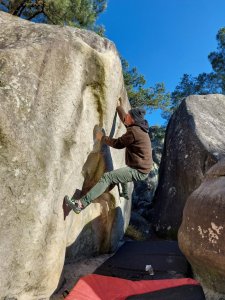
He still goes on climbing trips abroad. “In January this year, I went bouldering with my son in Fontainebleau, France, and in late January, I went with a friend to Leonidio in Greece. Last year, I was in the Peak District in the UK with my family, as both my daughter, Merel, and my son, Pepijn, climb. Climbing, for me, is an outdoor sport. I still love to go climbing outdoors.”
Setting up parKLIMson
In January 2025, his Parkinson’s meant Ton had to take leave from work. But rather than rest, he got busy.
After chatting with a sports doctor about research that showed the benefits climbing has for people with Parkinson’s, Ton read a study which found that a group of 48 people with Parkinson’s who undertook a 12-week climbing course recorded an improvement in their symptoms.
He then came across Molly Donelan-Cupka, who in 2012 founded Up Ending Parkinson’s, a network of more than 70 climbing groups for people with Parkinson’s in the US. After a conference call with Donelan-Cupka, Ton decided that he wanted to follow in her footsteps by setting up climbing groups for people with Parkinson’s in the Netherlands. “She inspired me,” he says.
Ton turned to his longtime close friend, Leo Broekmans, who he met in 1988 at the ESAC introductory session. “We had – and still have – some adventures when climbing together,” says Ton. Leo now runs a network of climbing gyms across the Netherlands.
“I asked Leo to support starting a climbing group for people with Parkinson’s,” says Ton. Together they founded parKLIMson, a not-for-profit organisation that runs sessions for people with Parkinson’s in climbing gyms.
Setting up parKLIMson forced Ton to face his diagnosis. After telling close family and friends, he said he had “‘put it in a box’ and tried to continue as if nothing happened”.
But once he decided to found parKLIMson, something changed. “As I was leading the initiative, I decided to tell everyone who asked that I have Parkinson’s. I just flipped the switch.”
In early 2025, Ton and Leo entered parKLIMson into a competition run by Parkinson Nederland, which raises money for Parkinson’s research and education in the Netherlands. It was offering grants for the three best initiatives that would improve the daily lives of people with the condition.
parKLIMson was one of three winning entries to secure 15,000 euros, which will help finance its expansion in the coming year.
parKLIMson makes progress
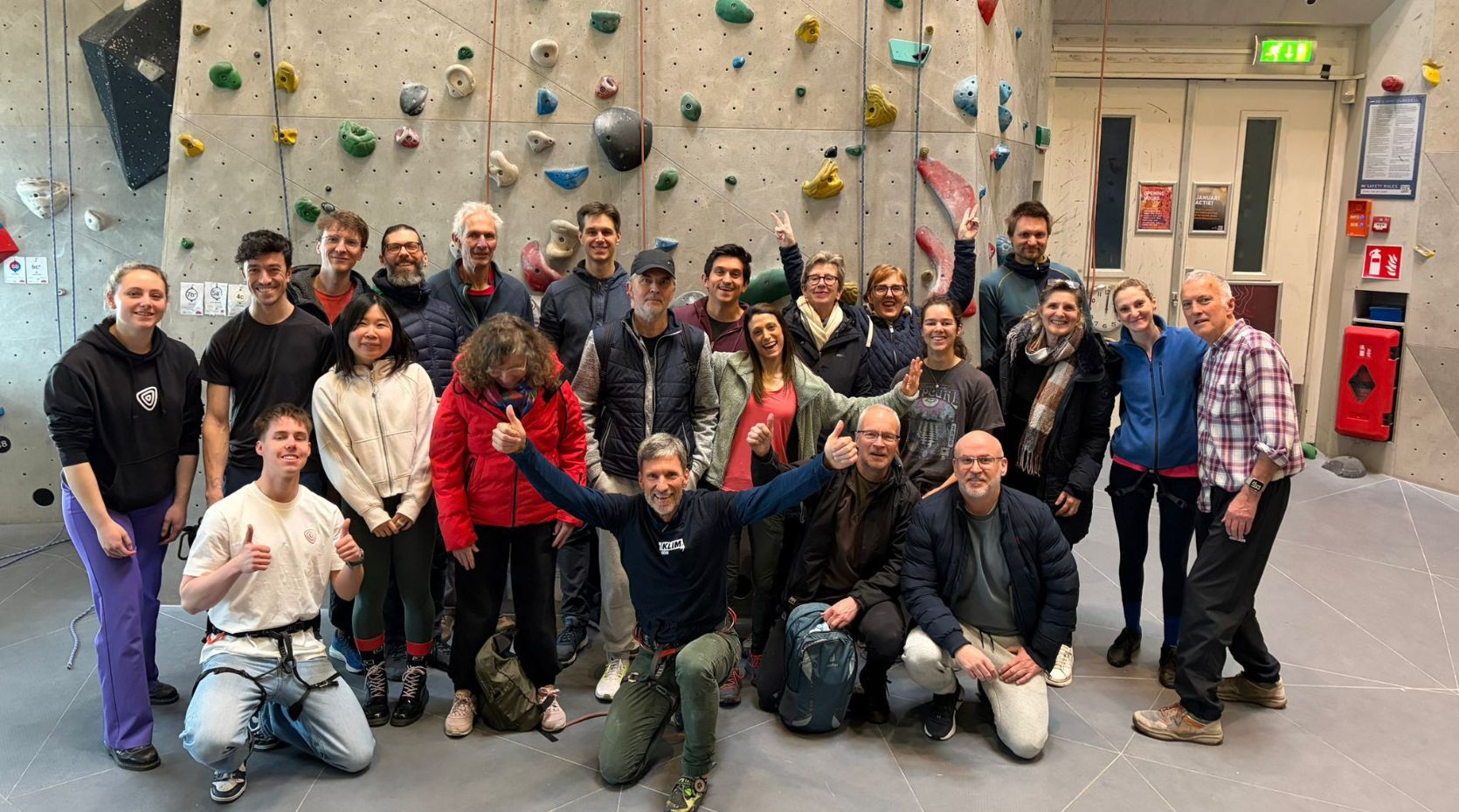
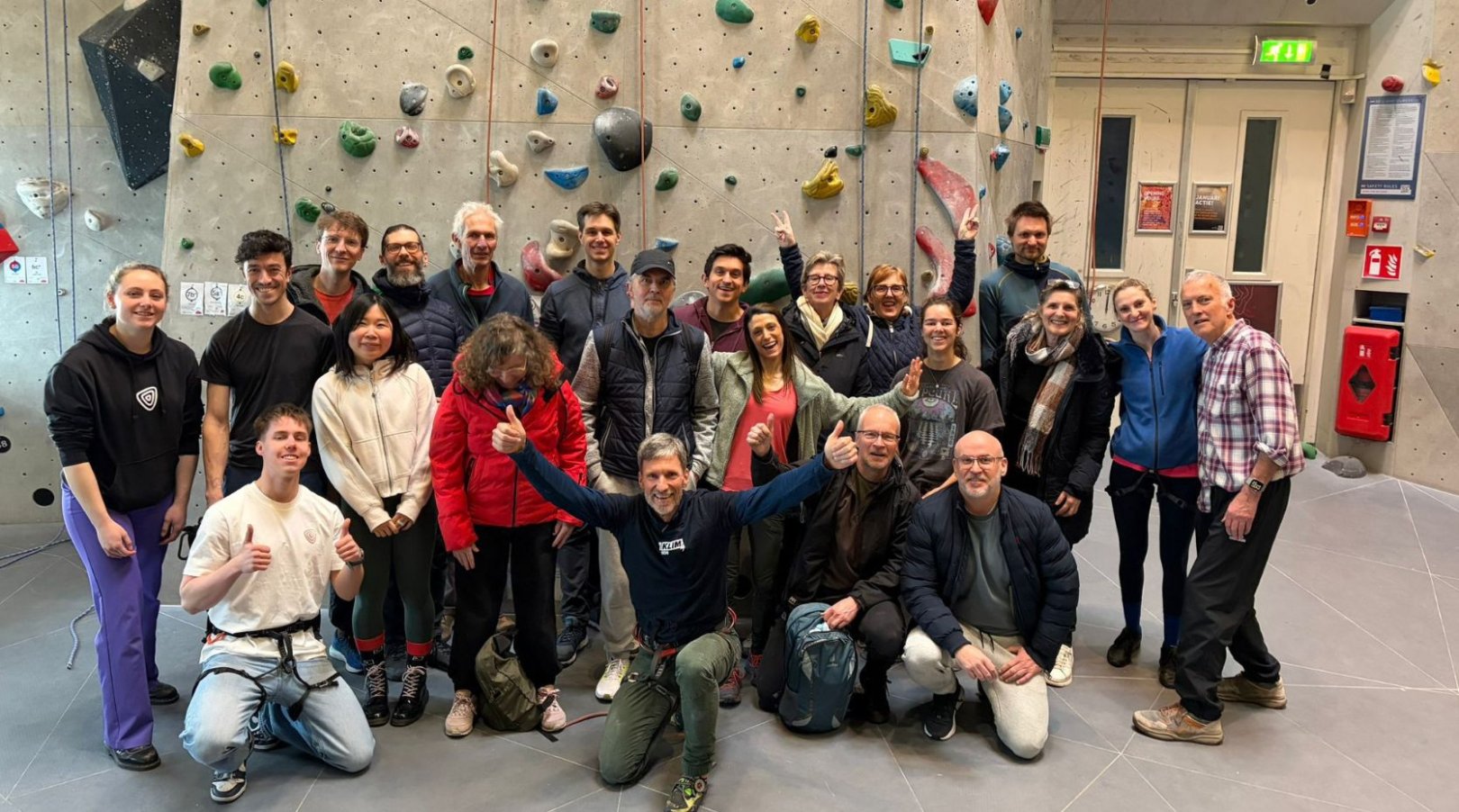
Ton and Leo are already making fantastic progress. In August 2025, they started a pilot Parkinson’s climbing group in Eindhoven, which now has about eight members. In November 2025, they started a Parkinson’s climbing group in Nijmegen, and ran an introduction to climbing event in Tilburg for people with Parkinson’s, as well as for Parkinson’s healthcare professionals. There, Spanish paraclimbing champion Jordi Cruz Gomez, who has the condition, gave a talk about climbing and his journey with Parkinson’s.
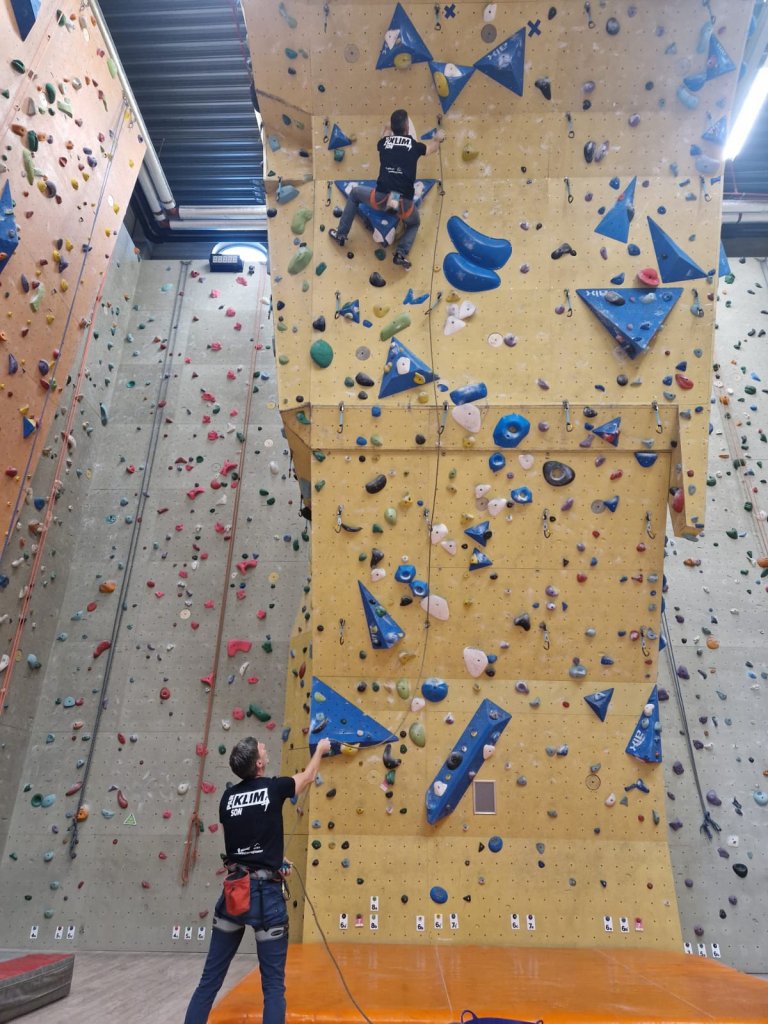
Currently, there are six parKLIMson locations in Eindhoven, Nijmegen, Tilburg, Utrecht, Amsterdam and Zwolle, with the latter three opening just this year.
Ton admits, however, that it can be difficult to find people with Parkinson’s who want to take part. “It’s not because they do not like climbing, but because climbing is relatively unknown, and climbing with Parkinson’s is even less known about,” he says. “Climbing has the image of being unsafe and only for adrenalin junkies and that you have to be fit and strong. But with the climbing groups, we prove the opposite!”
Climbing with parKLIMson
parKLIMson’s climbing groups are open to people of all ages and at all stages of the disease. When walking becomes more difficult or strength is diminishing, climbing can improve fitness, strength and balance, says Ton.
At the two-hour sessions, which start with a warm-up (conducted while sitting or standing), participants learn basic climbing technique with an instructor at a ratio of one-to-one or one-to-two. Because you’re attached to a rope, there’s no risk of falling and injuring yourself.
“Everyone can train at his/her own level,” says Ton. There are plenty of rest breaks, including a coffee break halfway through, where participants can chat with others.
parKLIMson climbers
Pascal has joined the parKLIMson sessions in Eindhoven. In his fifties, he has been diagnosed with Parkinson’s and is now very active. He had never climbed before, but it seemed like a great addition to his running training and that it might be more fun than regular fitness classes: “I read an article about climbing with Parkinson’s in the Eindhovens Dagblad newspaper and signed up for an introductory class,” he says. “Climbing seemed fun and challenging. Research has shown that it helps combat Parkinson’s symptoms, so that’s great. This way, I can exercise with others who have Parkinson’s, and their condition is taken into account.”
Discussing what climbing can do for people with Parkinson’s, he says: “You make movements you wouldn’t normally make so easily. It’s also good training for your balance. They carefully consider your level of ability. The instructor tailors this completely to my needs. The advantage of climbing is that all kinds of people at different levels can climb simultaneously.”
Leopold, a 77-year-old with Parkinson’s who also attends the Eindhoven parKLIMson classes, adds: “They take your needs into account, and there are many volunteers to guide us. That’s something I really appreciate; thanks to them, climbing is possible for us.”
Jos, 71, read the same article as Pascal and decided to sign up for climbing sessions in Eindhoven immediately. Unlike the others, he had climbed before. “I stopped climbing partly because of Parkinson’s, but now I’ve started climbing again because of Parkinson’s. I thought it would be fun to climb again, especially knowing that it’s good therapy for me and many others with Parkinson’s.”
Pascal also finds the social aspect important. “This way, I connect with other people with Parkinson’s and can share experiences. It’s also a great atmosphere before or after the class.”
Jos agrees: “I thought it would be nice to climb with other people with Parkinson’s. I hope to find climbing buddies here so we can climb outside on Friday mornings.”
Pascal says of his new hobby: “When climbing, you don’t have time to think about anything else but climbing. After two hours of climbing, I feel like I can take on the world! Climbing is fantastic.”
Future plans
As for the future, Ton plans to expand parKLIMson. “My ambition and main focus is to set up a Parkinson’s group in every climbing gym in the Netherlands,” he says.
He also intends to set up a platform where people with Parkinson’s who are interested in climbing can get in touch with volunteer climbing instructors to teach them. He also wants to invest in more research on climbing and Parkinson’s.
“The vision is to have a large group enjoying climbing, and through climbing slow down the progress of Parkinson’s,” he says.
Ton stresses the importance of people with the condition doing a physical activity and finding one they enjoy. “It really makes a difference in slowing the progress of Parkinson’s, so it is worthwhile. But if you do not like it, you will not keep doing it.
“Don’t hesitate to try climbing – it is safe, it trains the whole body and balance. And you also need to solve the puzzle of how to move from one hold to the next, so it trains the brain. It is a very safe sport – the way we execute it – and, above all, it is fun!”
Are you interested in giving climbing a go at a parKLIMson session? Find out more here