Galloway, N.J. — Norina Cobb witnessed the effects of Parkinson’s disease firsthand. She just wasn’t aware of it.
Her father, Brian, showed symptoms before his death in March 2024 from a rare viral infection.
“Finding out when he was in the hospital made me think deeper about the symptoms that were present prior to his passing,” said Cobb, a first-year student in the master’s in Communication Sciences and Disorders program at Stockton University. “None of us knew. None of us picked up on it because there are a lot of symptoms that people aren’t aware of beyond tremors and speech issues.”
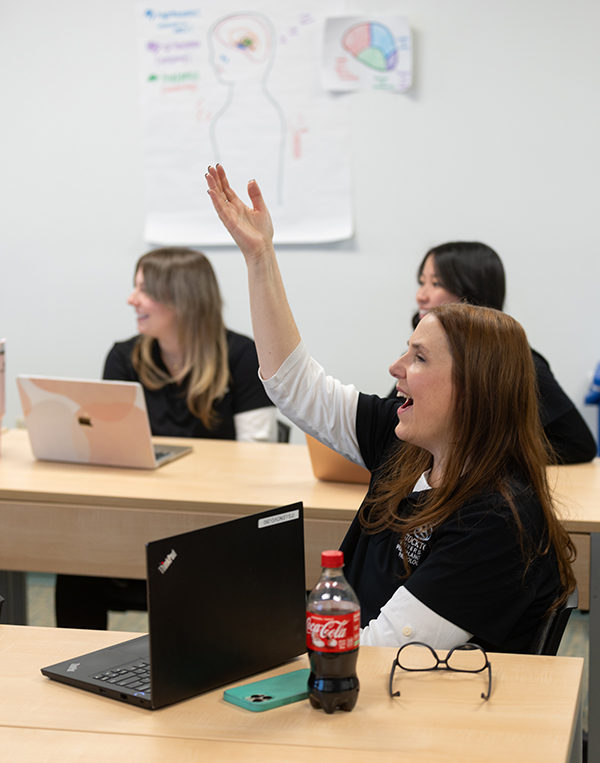
Kelly Maslanik, a clinical specialist, demonstrates to a group of students in the Communication Sciences and Disorders program some of the techniques used in the Parkinson Voice Project.
The 24-year-old from Cherry Hill remembered her father — a former minor league umpire who loved sharing stories with his family — often speaking at a lower tone.
“We would always say, ‘What did you say, Dad?’,” Cobb said. “For individuals with Parkinson’s it’s very difficult for them to monitor how loud or how soft they are.”
Now, through the SPEAK OUT! Therapy & Research Center at Stockton’s Speech and Hearing Clinic, Cobb helps others combat the symptoms of the world’s fastest growing neurological disorder.
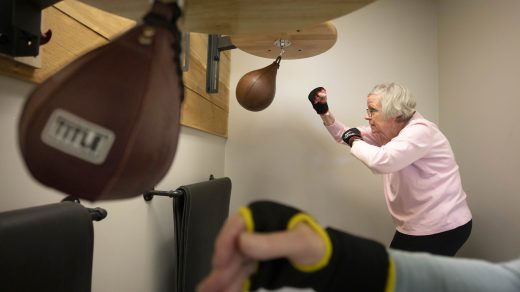
Early in 2025, the Texas-based Parkinson Voice Project selected Stockton to represent New Jersey and become one of 28 centers throughout the country. The nonprofit provided $50,000 to launch the center and training for Stockton’s faculty and students over a five-year period at the clinic at 10 W. Jimmie Leeds Road in Galloway. The center opened this summer, providing all New Jersey residents access to free in-person and virtual speech treatment.
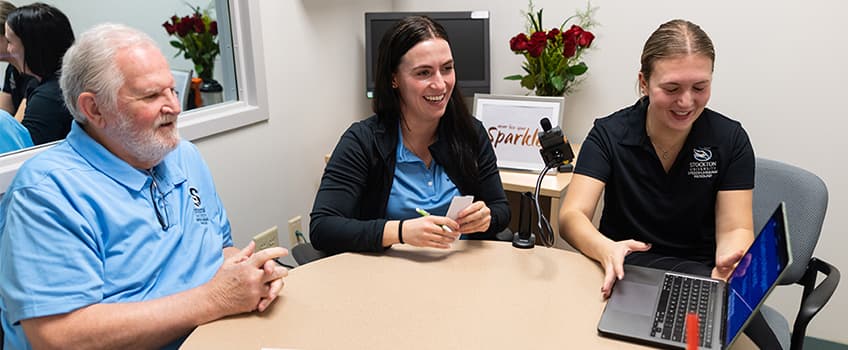
The clinic offers individual and group sessions, led by Michelle Swartz, assistant professor of Communication Sciences and Disorders, and Kelly Maslanik, a clinical specialist with Stockton’s program. Swartz and Maslanik also train and work with students who are conducting research. Currently, about 30 people have signed up for the classes.
Maslanik began a recent online class by encouraging participants to repeat the sounds “may, me, my, moe and moooo.” Maslanik then asked them to say “ah” several times, reminding them to keep their mouths open wide and envision the sound climbing up a ladder and going down a slide.
The exercises target the throat and mouth muscles in an effort to take automatic actions, such as speaking and swallowing, and make them more purposeful or intentional, Maslanik said. The part of the brain tied to automatic functions requires more dopamine, a hormone created by nerve cells that are attacked by Parkinson’s. The part of the brain tied to more intentional thoughts and actions doesn’t require as much dopamine.
One of the most common causes of death in Parkinson’s patients is they choke on their secretions or on food or liquids due to difficulty swallowing, Maslanik said.
“Through these exercises, we are targeting the voice, the volume, the loudness, the intention, but we’re also, because it’s similar muscles, targeting the swallow as well,” Maslanik said. “The more we can educate everyone, the better they are. The more participation that we get and the more they buy into SPEAK OUT! and use it at home, the more they will preserve their speech.”
John Gaynor, 71, was diagnosed with Parkinson’s five years ago and he’s had tremors going back about 12 years. He’s been with Stockton’s program since July and loves the fact that it’s in person.
“It’s intimate. It’s close,” said the Egg Harbor Township resident. “I enjoy being able to read facial expressions. It just feels more personal.”
In addition to the sessions held at Stockton, participants also have access to extensive resources through the Parkinson Voice Project’s website, including home practice sessions and video lessons — all at no cost. Gaynor said he takes advantage of the extra resources to practice every day and comes to the Stockton sessions twice a week.
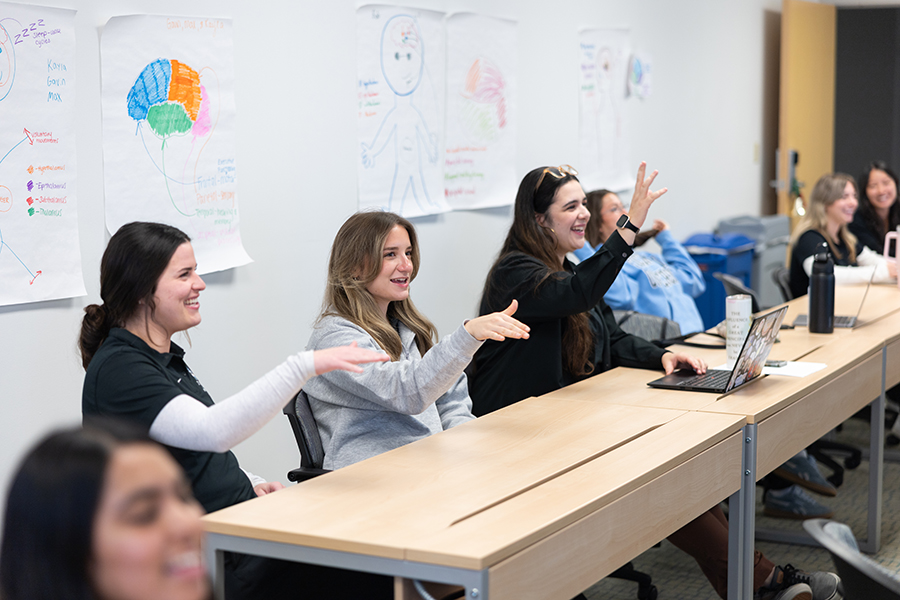
Last year, the Texas-based Parkinson Voice Project selected Stockton to represent New Jersey as a SPEAK OUT! Therapy & Research Center. The nonprofit provided $50,000 to train Stockton’s faculty and students over a five-year period.
“It’s the difference between me losing my voice and not losing my voice. It’s cut and dry in my mind,” he said. “Strengthening those muscles and learning how to think of something that previously I just took for granted and needing that constant reminder is so important.”
For Paul Chaballa, 75, the group sessions have been invaluable. He noticed a few years ago that he was having tremors and that his voice would taper off and get quieter and quieter. His voice was strong during the session as he explained that he’s very much aware of what’s happening to him.
“Even now, I can feel it coming on,” said the Middletown Township resident. “I have to constantly remind myself about intent — what am I going to say, how am I going to say it, and am I pronouncing and enunciating myself clearly so that everyone hears me. It’s not perfect. I still stumble with it.”
But there’s no doubt the sessions, especially the group ones, are beneficial.
“Watching other people and watching what they have to go through, there is a certain similarity there,” Chaballa said. “We all kind of join forces and have the whole attitude that we’re in this together.”
Being an instructor has been life changing for Cobb and reinforced that being in Stockton’s Communication Sciences and Disorders program is where she needs to be.
“We don’t realize how much our voices and our speech make us an active member in each other’s lives until you lose it, or someone close to you loses it,” she said. “If you’re able to help someone be an active member and talk to their family, talk to their loved ones and have an active social life for longer, then I believe that’s the greatest gift you could provide to anyone in their life.
“After being a part of the SPEAK OUT! program, my heart is set, and it feels like I know what I want to do for the rest of my life,” Cobb said.
Call 609-652-4920 to schedule an online or in-person SPEAK OUT! evaluation in English or Spanish. For workshops or research inquiries, email [email protected] or [email protected].
— Story by Mark Melhorn, photos by Susan Allen